
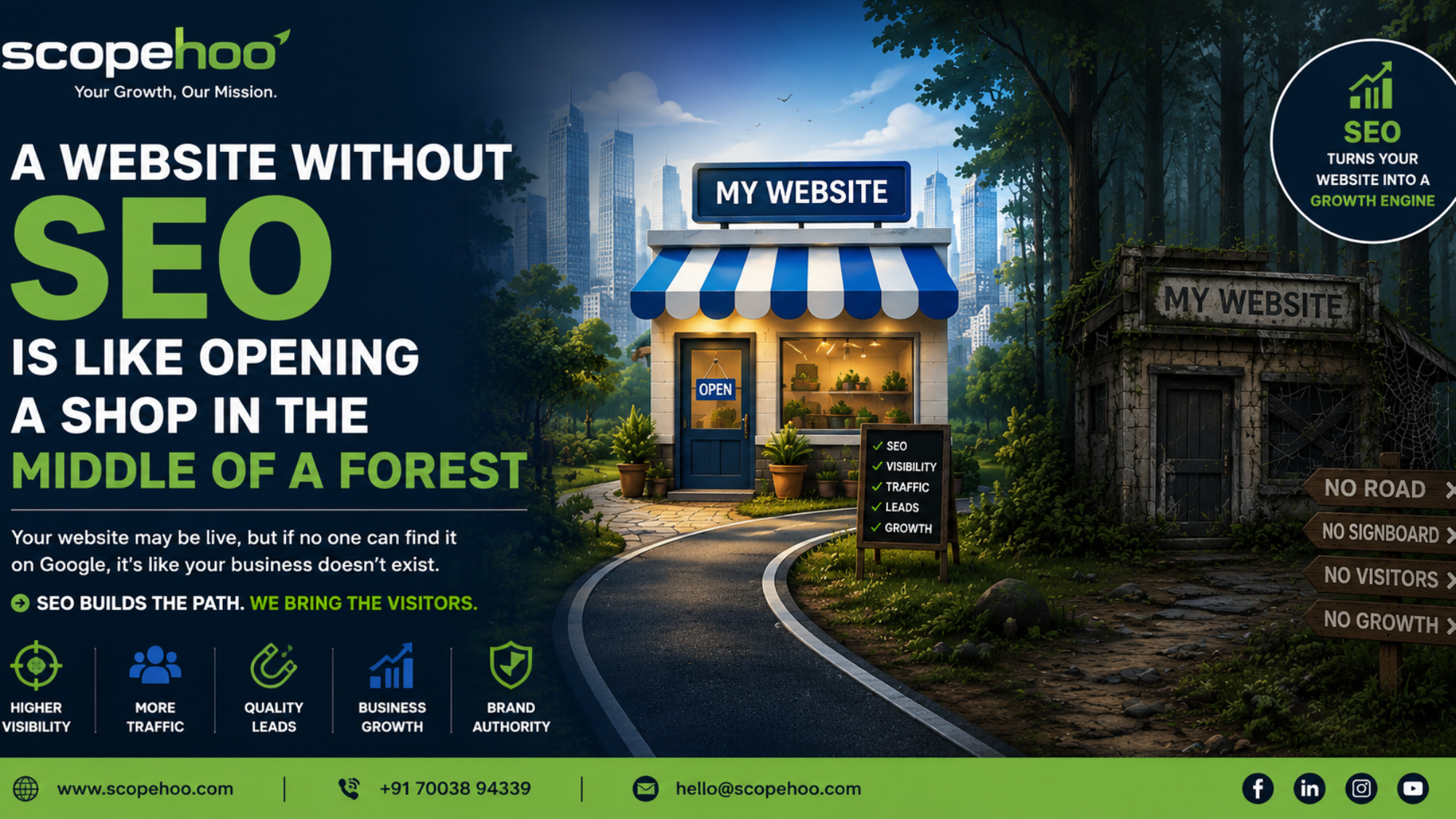
Launching a professional website is exciting. It gives your business an online presence, showcases your products or services, and establishes credibility. However, many business owners make one costly mistake—they believe that simply having a website is enough to attract customers.
The truth is far different.
A website without SEO is like opening a beautiful shop in the middle of a dense forest. The shop exists, it’s fully stocked, and it’s ready to serve customers—but no one knows it’s there.
Without roads, signboards, maps, or directions, customers will never find your store.
The same principle applies to your website.
Without Search Engine Optimization (SEO), search engines like Google struggle to discover, understand, and recommend your pages. As a result, your ideal customers end up finding your competitors instead.
Today, this is even more important because visibility isn’t limited to Google Search. AI-powered platforms like Google AI Overviews, ChatGPT, Gemini, Microsoft Copilot, and Perplexity AI are changing how users discover businesses online. If your website isn’t optimized for both search engines and AI search, you’re missing valuable opportunities to reach potential customers.
Your Website Being Live Doesn’t Mean People Can Find It
Many businesses invest heavily in:
- Website Design
- Branding
- Professional Photography
- Product Pages
- Service Pages
- Blogs
Then they launch their website and wait for customers.
Weeks pass.
Months pass.
Traffic remains low.
Leads don’t increase.
Sales remain stagnant.
The problem isn’t necessarily your website.
The problem is visibility.
Search engines don’t automatically rank every new website.
Instead, they evaluate hundreds of ranking signals before deciding whether your pages deserve to appear in search results. Without SEO, Google has very little reason to show your website to users searching for your products or services.
SEO Is No Longer Just About Google Rankings
Search behavior has changed dramatically.
Instead of typing short keywords, users now ask complete questions like:
- Why isn’t my website getting visitors?
- How can I improve my Google ranking?
- How do I get my business found online?
- Why doesn’t my website generate leads?
- How do I optimize my website for AI search?
Modern SEO focuses on answering these real-world questions clearly and comprehensively.
This improves your chances of appearing in:
- Google Search
- Google AI Overviews
- ChatGPT recommendations
- Microsoft Copilot
- Perplexity AI
- Gemini
- Voice Search results
How AI Search Is Changing Website Visibility
Artificial Intelligence is reshaping how people search for information.
Rather than browsing multiple websites, users increasingly expect AI to provide direct answers.
To appear in AI-generated responses, your content should include:
- Clear H2 and H3 headings
- Conversational language
- FAQ sections
- Structured data (Schema Markup)
- Semantic keywords
- Entity-based optimization
- Helpful, experience-driven insights
Businesses that optimize for AI search today are preparing for the future of online discovery.
SEO vs Paid Advertising: Which Is Better?
| SEO | Paid Advertising |
|---|---|
| Builds long-term visibility | Provides immediate traffic |
| Generates sustainable organic leads | Traffic stops when ads stop |
| Improves trust and authority | Depends on ad spend |
| Delivers better long-term ROI | Can become expensive over time |
The strongest digital marketing strategies use SEO and paid advertising together, but SEO provides the foundation for lasting online growth.
uture-Proof Your Business with SEO and AI Search Optimization
Search is evolving rapidly. Businesses that embrace both traditional SEO and AI search optimization will be better positioned to attract customers in the years ahead.
Focus on:
- Creating helpful, user-first content
- Answering conversational search queries
- Optimizing for semantic relevance
- Improving technical website performance
- Implementing structured data
- Building topical authority through consistent publishing
These practices help your website perform well across search engines and AI-powered discovery platforms alike.