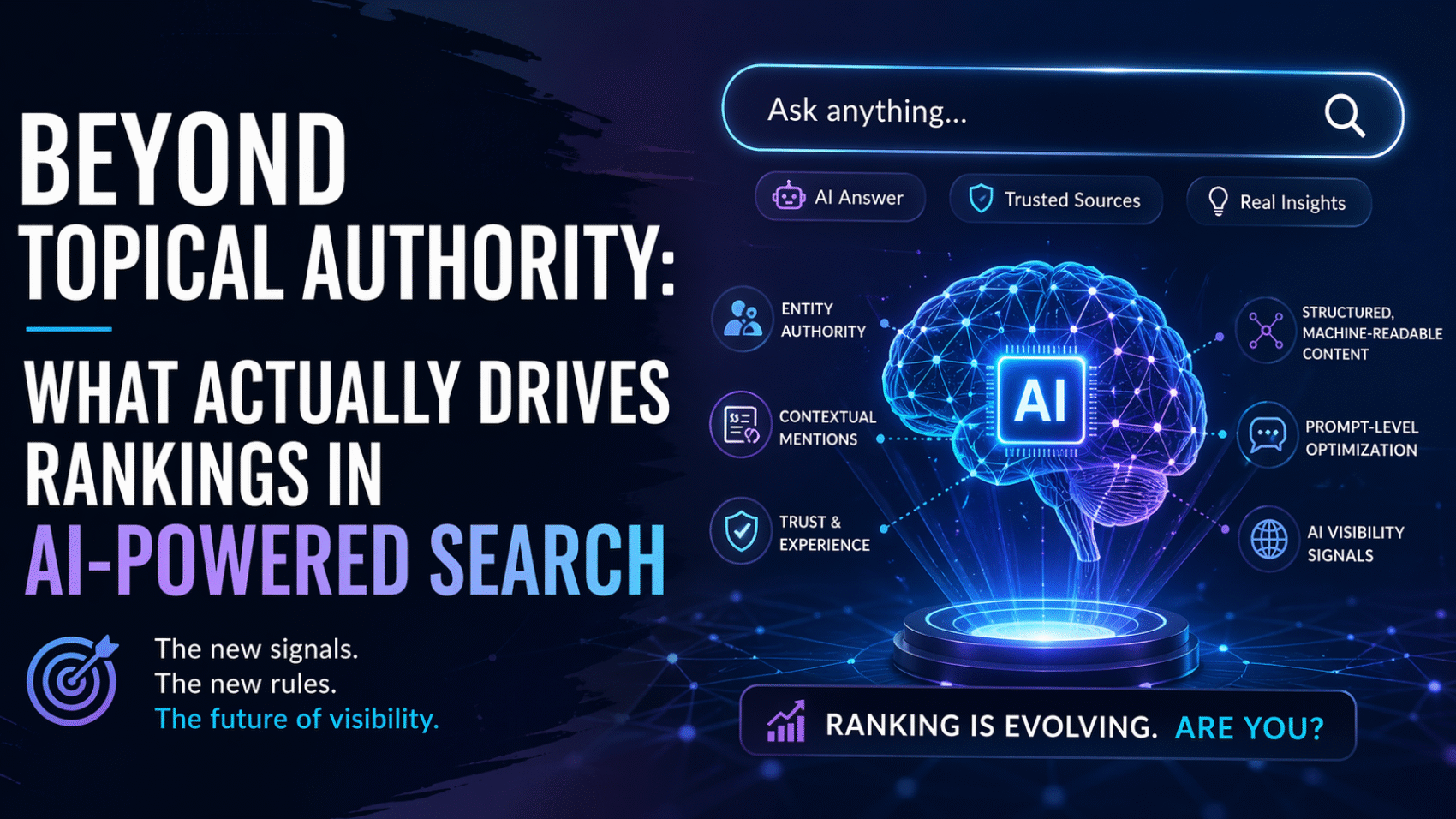
Brand Mentions & Authority Signals

Brand Mentions & Authority Signals in AI Search Engines

How Brand Mentions and Authority Signals Drive Visibility in AI Search Engines

Search visibility is no longer defined only by rankings on Google. As AI-powered search tools like ChatGPT and Perplexity become primary discovery channels, brands must rethink how they earn attention. AI search engines do not display lists of websites. They generate answers, recommendations, and summaries based on trust, relevance, and contextual understanding.

At the center of this shift are brand mentions and authority signals. These elements shape how AI models interpret which brands deserve to be referenced when users ask questions.

Why AI Search Engines Value Brand Mentions Over Rankings

Traditional SEO rewards pages that match keyword intent and earn backlinks. AI search engines operate at a different layer. They analyze patterns across massive datasets to understand which brands are consistently discussed in credible contexts. A brand mention, even without a link, acts as a signal that a brand exists within a trusted knowledge network.

When a brand is mentioned across articles, blogs, expert commentary, and discussions related to a specific topic, AI systems begin to associate that brand with subject-matter expertise. Over time, this association increases the likelihood of the brand being referenced in AI-generated responses.

This is why some brands appear in AI answers despite not ranking first on Google. Their visibility is built on contextual authority rather than pure keyword performance.

Understanding Authority Signals in AI Search

Authority signals go beyond backlinks and domain metrics. AI models look for consistency, clarity, and credibility across multiple sources. These signals help AI determine whether a brand should be trusted when forming an answer.

Key authority signals include:

  • Consistent brand mentions in authoritative content
  • In-depth educational material that explains complex topics clearly

These signals tell AI models that a brand is not just publishing content, but contributing meaningful knowledge to a topic.

The Role of Contextual Relevance in AI Visibility

Context is one of the most important factors in AI search visibility. AI models do not evaluate content in isolation. They examine how information fits into broader conversations. If a brand appears repeatedly in discussions about a specific problem, industry, or solution, AI systems learn that the brand is relevant to that context.

This is where many brands struggle. Publishing scattered content across unrelated topics weakens contextual clarity. Brands that focus on a defined niche and build layered content around it are easier for AI models to understand and recommend.

Contextual relevance also depends on language. Content written in natural, explanatory terms aligns better with how users phrase questions in AI tools. This increases the chance of being surfaced in conversational search results.

Entity-Based SEO and How AI Models Interpret Brands

AI search engines rely heavily on entity recognition. An entity can be a brand, product, company, or concept. When AI models clearly recognize a brand as an entity and understand what it represents, that brand becomes easier to retrieve during answer generation.

Entity-based SEO is not about keyword repetition. It is about clearly defining who you are, what you do, and how you relate to specific topics. Consistent descriptions across content, clear positioning, and authoritative explanations help AI systems map a brand accurately.

When entity clarity is strong, AI models can confidently reference a brand without ambiguity.

Why Brand Trust Matters More Than Traffic

In AI search, visibility is earned through trust, not clicks. AI tools aim to reduce misinformation and provide reliable answers. As a result, they prefer sources and brands that demonstrate expertise over time.

A single viral article rarely creates AI visibility. Instead, trust is built through sustained presence, consistent messaging, and repeated validation across the web. Brands that invest in long-term authority building are far more likely to be included in AI-generated answers.

How Scopehoo Helps Brands Build AI Search Authority

Scopehoo focuses on helping brands strengthen the signals that AI search engines value most. By improving brand mentions, contextual relevance, and authority positioning, Scopehoo enables brands to align with how AI models interpret trust and expertise.

Rather than chasing short-term rankings, this approach builds durable visibility across both traditional search and AI-driven discovery platforms. As AI search adoption accelerates, brands with strong authority foundations will benefit the most.

The Future of AI Search Visibility

AI search engines are becoming the first point of research for users across industries. As this behavior grows, brand visibility will depend less on individual pages and more on overall reputation and relevance.

Brand mentions, authority signals, and contextual clarity are no longer supporting factors. They are core drivers of visibility in AI search engines. Brands that understand and act on this shift today will define how they are discovered tomorrow.

Content Strategy for Small Businesses in 2025

Why Blogging is Still the 1 Content Strategy for Small Businesses in 2025

Since digital trends, short-form videos and AI gained popularity, one might assume that blogging is no longer popular. While there may be new marketing approaches, blogging will still be the most important strategy for building a strong brand, getting organic website traffic and bonding with readers in 2025. Find out why the classic format remains popular and how your business can use it to the fullest.

1. Unmatched SEO Value

Blogging is a foundational element of any successful SEO strategy. Search engines like Google favor fresh, relevant, and in-depth content when determining rankings. Each blog post represents a new opportunity to target valuable keywords, answer search queries, and earn backlinks—all of which help increase your website’s visibility in search results.

For small businesses, especially those in competitive local markets, ranking organically can save thousands in advertising costs.

2. Establishes Authority and Trust

Customers are more likely to buy from brands they trust. Blogging allows small businesses to showcase their expertise, share insights, and educate their audience. When you consistently publish high-quality content that solves problems or answers questions, your brand becomes a go-to resource in its niche.

Whether it’s “how-to” guides, FAQs, or opinion pieces, your blog can position you as an industry leader.

3. Drives Long-Term ROI

Unlike ads that stop delivering results when you stop paying for them, a well-written blog post continues to drive traffic and leads for months or even years after it’s published. Evergreen content—content that remains relevant over time—is especially valuable for long-term ROI.

One high-performing blog post can:

  • Attract new visitors daily
  • Convert leads over time
  • Support your sales funnel

4. Supports Multi-Channel Marketing

Blog content doesn’t live in isolation. It fuels your entire content marketing ecosystem. Blog posts can be repurposed into:

  • Social media posts
  • Email newsletters
  • Video scripts
  • Infographics

This makes blogging a cost-effective engine that powers other marketing channels.

5. Engages and Educates Your Audience

Small businesses thrive on strong relationships with their customers. Blogs provide a space to address pain points, highlight success stories, and even share behind-the-scenes insights. In 2025, authenticity and transparency are more valued than ever.

Your blog can act as a direct line to your audience, encouraging comments, shares, and community-building.

6. Adapts Easily to AI and Automation

While AI tools have changed how content is created, blogging remains adaptable. Small businesses can now use AI for:

  • Topic generation
  • Content outlines
  • Keyword research

This enhances productivity while maintaining a human touch—something that still resonates strongly with readers.

Final Thoughts

For small businesses in 2025, blogging is not a relic of the past—it’s a strategic asset. It combines the benefits of visibility, authority, engagement, and long-term growth like no other content format.

If you’re not blogging yet, now is the time to start. And if you are, refine your strategy to ensure each post serves your broader business goals.

At ScopeHoo, we help small businesses craft compelling blogs that get noticed—and get results.

Ready to turn your blog into your most powerful marketing tool? Contact ScopeHoo today and let’s build your content empire, one post at a time.

UX/UI: Trends to Watch in 2025

The Future of Website UX/UI: Trends to Watch in 2025

As we move deeper into the digital era, website user experience (UX) and user interface (UI) design are evolving at an unprecedented pace. The rapid advancements in technology, changing user behaviors, and rising expectations are shaping how websites are designed and interacted with. Businesses and designers must stay ahead of these trends to create engaging, seamless, and conversion-driven experiences. In this article, we explore the most significant UX/UI trends that will dominate 2025 and how they will redefine the future of web design.

1. AI-Powered Personalization

Artificial intelligence (AI) and machine learning (ML) are revolutionizing web design by offering hyper-personalized user experiences. Websites are leveraging AI algorithms to analyze user behavior, preferences, and browsing history to present tailored content, product recommendations, and navigation paths. Expect to see:

  • AI-driven chatbots providing real-time customer support.
  • Dynamic content customization based on user interests.
  • Predictive UI, which adjusts elements according to user habits.

2. Voice and Gesture-Based Navigation

With the proliferation of smart assistants like Alexa, Siri, and Google Assistant, voice search and voice-controlled interactions are becoming mainstream. Websites will start integrating:

  • Voice-activated search features for hands-free browsing.
  • Gesture-based navigation for an intuitive, touch-free experience.
  • Conversational UX that mimics human-like interactions.

3. Dark Mode and Adaptive Design

Dark mode has already gained popularity, and in 2025, it will become a standard feature. Alongside dark mode, adaptive design principles will ensure a more comfortable and eye-friendly browsing experience. Trends include:

  • Websites with automatic theme-switching based on user preferences.
  • Energy-efficient UI elements that reduce eye strain.
  • Greater emphasis on accessibility features for all users.

4. Immersive Augmented Reality (AR) and Virtual Reality (VR)

The integration of AR and VR in website design will enhance interactivity, particularly for e-commerce and real estate sectors. Key developments include:

  • AR-powered virtual try-ons for online shopping.
  • 360-degree product views for a realistic shopping experience.
  • VR-based tours for hotels, real estate, and travel websites.

5. Microinteractions and Advanced Animations

Microinteractions play a crucial role in improving UX by providing instant feedback and guiding users intuitively. These small, yet impactful design elements include:

  • Hover effects and smooth transitions.
  • Animated icons and buttons for a more engaging experience.
  • Gamification elements to enhance user interaction.

6. No-Code and Low-Code Platforms

No-code and low-code development platforms are simplifying website creation, making it easier for businesses to design and deploy web applications without extensive coding knowledge. This trend will continue to grow with:

  • Drag-and-drop website builders with AI-powered design recommendations.
  • More customization options for businesses without hiring a development team.
  • Faster prototyping and iterative design processes.

7. Sustainability-Driven Design

With growing concerns about environmental sustainability, websites in 2025 will focus on energy efficiency, minimalistic design, and eco-friendly practices. Some emerging trends include:

  • Lightweight website designs to reduce server load and energy consumption.
  • Green hosting solutions that use renewable energy.
  • Sustainable UX principles that prioritize digital accessibility and inclusivity.

8. Advanced Cybersecurity Measures in UX

As cyber threats continue to rise, website security will become a fundamental part of UX design. Expect enhanced security measures such as:

  • Biometric authentication (facial recognition, fingerprint scanning).
  • Multi-factor authentication (MFA) for secure logins.
  • Privacy-first UX design focusing on transparency in data collection.

9. Hyper-Minimalistic and Neumorphic Design

Neumorphism, a blend of skeuomorphism and flat design, is making waves in UI design. It brings a soft, 3D-like appearance to elements, enhancing usability. Additionally, hyper-minimalism is gaining traction, characterized by:

  • Clean, distraction-free layouts.
  • Large typography for readability.
  • Smooth, intuitive navigation.

10. Inclusive and Ethical Design

Diversity and inclusivity in web design will be more prominent than ever, ensuring accessibility for users of all backgrounds and abilities. Ethical considerations will also shape UX/UI strategies, including:

  • Websites optimized for screen readers and keyboard navigation.
  • Gender-neutral and culturally inclusive designs.
  • Ethical AI ensuring unbiased and fair user interactions.

How ScopeHoo.com Can Help

Staying ahead in UX/UI trends requires expertise, innovation, and a user-centric approach. ScopeHoo.com specializes in cutting-edge website design solutions, integrating the latest trends to create visually stunning and functionally superior websites. Whether you need AI-powered personalization, immersive AR experiences, or a cybersecurity-first approach, ScopeHoo.com can elevate your digital presence. By leveraging advanced UX/UI methodologies, they ensure that your website remains competitive, engaging, and optimized for the future.

Final Thoughts The future of UX/UI design in 2025 is driven by technological innovation, user-centered experiences, and sustainability. Businesses that embrace these trends will stand out in an increasingly digital landscape. By partnering with industry leaders like ScopeHoo.com, you can ensure that your website is not only aesthetically appealing but also future-proofed for the ever-evolving digital world.

How to Rank Your Instagram, LinkedIn & Twitter Posts on Google

How to Rank Your Instagram, LinkedIn & Twitter Posts on Google

The modern digital environment depends on Instagram alongside LinkedIn and Twitter to build brand awareness through platform engagement. Your social media content has the ability to achieve Google search ranking which generates natural traffic to your platform. Online visibility elevation depends heavily on the optimization of your posts to achieve good results in search engine rankings. The following section explains proven approaches to boost Google rankings of your social media posts.

1. Optimize Your Social Media Profiles

Before you start optimizing individual posts, ensure your profiles are fully optimized for search engines.

  • Use a clear and relevant username: Choose a username that reflects your brand or niche.
  • Write an SEO-friendly bio: Include primary keywords and a compelling description of your profile.
  • Add links to your website: Drive traffic from your social media to your official website, boosting credibility.
  • Use a professional and recognizable profile picture: This helps with brand recall and searchability.

2. Use Keywords Strategically in Your Posts

Google indexes social media posts that have relevant and searchable content. Here’s how you can optimize yours:

  • Research trending and long-tail keywords: Use tools like Google Keyword Planner or Ubersuggest to find high-ranking keywords.
  • Include keywords naturally in your captions, tweets, and post descriptions.
  • Use relevant hashtags: These help increase visibility within the platform and in search results.

3. Make Your Content Public and Shareable

Private or restricted posts won’t appear in search results.

  • Ensure your profiles and posts are public so Google bots can crawl them.
  • Encourage sharing: The more your content is shared, the higher its chances of ranking.
  • Embed posts on websites and blogs to create backlinks.

4. Leverage Hashtags and Trending Topics

Hashtags act as search signals on both social platforms and search engines.

  • Use branded, industry-specific, and trending hashtags.
  • Avoid overstuffing: Stick to a limited number of highly relevant hashtags.
  • Engage with trending topics to increase your reach and potential search rankings.

5. Create Engaging and High-Quality Content

Quality content is a priority for both social media and search engines.

  • Write compelling, informative, and shareable posts.
  • Use high-resolution images and videos: Google favors visually engaging content.
  • Post consistently: Regular activity increases visibility and credibility.

6. Optimize Your LinkedIn Articles & Twitter Threads

  • LinkedIn Articles: Google indexes LinkedIn articles, so ensure your articles are well-structured with keywords, proper headings, and internal/external links.
  • Twitter Threads: Create informative threads with keyword-rich tweets and encourage retweets for better visibility.

7. Build Backlinks to Your Social Media Posts

Backlinks are a crucial ranking factor.

  • Embed social media posts in your blogs or guest articles.
  • Encourage other websites to link to your posts.
  • Get featured on reputable sites that mention your social media content.

8. Engage with Your Audience

Google prioritizes content that shows engagement and interaction.

  • Reply to comments and mentions.
  • Encourage discussions.
  • Run polls, ask questions, and create interactive content to increase user engagement.

9. Use Google My Business for Social Visibility

If you’re a business, ensure your social media links are added to your Google My Business profile. This can help your social posts appear in search results under your business listing.

10. Monitor Performance and Adjust Strategies

Use analytics tools like Google Search Console, Twitter Analytics, and LinkedIn Insights to monitor which posts perform well in search rankings and optimize future content accordingly.

Final Thoughts

Ranking your Instagram, LinkedIn, and Twitter posts on Google requires a mix of strategic keyword placement, content optimization, engagement, and backlinking. By implementing these tactics, you can improve your social media visibility on search engines, ultimately driving more traffic and boosting your brand’s online authority. Start optimizing today and watch your social media content gain the visibility it deserves!

For more insights on digital marketing strategies, visit Scopehoo.com and stay ahead in the game!

Key Takeaways for E-commerce Businesses

The Booming Business of E-commerce in India and the Critical Role of SEO

India’s e-commerce landscape has undergone a transformative journey, becoming one of the fastest-growing markets globally. With millions of consumers shifting to online platforms for their shopping needs, the opportunities for businesses are immense. However, as competition intensifies, the key to standing out lies in effective search engine optimization (SEO). Here’s how businesses can leverage SEO to tap into India’s booming e-commerce potential.

Why SEO Is Crucial for E-commerce Success

SEO isn’t just about ranking higher on search engines—it’s about ensuring your target customers can find you when they need you most. Here are the reasons why SEO plays a pivotal role in E-commerce in India :

1. Enhancing Visibility Amidst Competition

With countless businesses vying for consumer attention, appearing on the first page of search results is essential. SEO helps your website rank higher, ensuring more users see your products before your competitors.

2. Driving Organic Traffic

Organic search traffic, driven by effective SEO, is one of the most cost-efficient ways to attract potential customers. Unlike paid ads, organic traffic continues to flow even after initial efforts, providing long-term benefits.

3. Building Trust and Credibility

Websites that rank higher are often perceived as more trustworthy by users. With the right SEO tactics—such as creating high-quality content and earning backlinks—your brand can establish authority in its niche.

4. Understanding Consumer Intent

SEO involves researching and targeting keywords that your audience frequently searches. This insight into consumer behavior helps businesses tailor their offerings and marketing efforts to meet customer needs effectively.

SEO Strategies for Indian E-commerce Business

Implementing a focused SEO strategy can significantly impact your online presence. Here are actionable steps businesses can take:

Many Indian consumers search for products with location-specific keywords, such as “best sarees in Jaipur” or “online grocery delivery in Mumbai.” By optimizing for local search terms, you can cater to this demand.

2. Mobile-Friendly Design

With the majority of online shoppers accessing sites via mobile devices, having a mobile-optimized website is non-negotiable. A seamless mobile experience not only improves user engagement but also boosts search rankings.

As voice search becomes increasingly popular in India, especially with regional language users, optimizing your content for natural language queries can give you an edge. Think conversational keywords and FAQs.

4. Prioritize Speed and User Experience

Indian consumers expect fast-loading websites and intuitive navigation. Slow-loading pages or complicated checkout processes can lead to higher bounce rates, negatively impacting SEO rankings.

5. Create Relevant, High-Quality Content

Content marketing is a powerful component of SEO. By crafting blogs, guides, and videos that address customer pain points, you can drive traffic and build trust. For example, a clothing brand might write a guide on “How to Style Ethnic Wear for Weddings.”

6. Leverage Regional Languages

With India’s linguistic diversity, creating content in regional languages can help you connect with a broader audience. Search engines prioritize localized content, making this a powerful SEO strategy.

Measuring Success: The Role of Analytics

SEO isn’t a one-time activity—it’s an ongoing process. Tools like Google Analytics and Search Console allow businesses to monitor their SEO efforts, identify trends, and adjust strategies to maintain a competitive edge.

Key Takeaways for E-commerce in India Businesses

  1. Start Early: Begin optimizing your site for SEO right from its inception to avoid costly corrections later.
  2. Focus on Quality: High-quality, relevant content and seamless user experiences are non-negotiable.
  3. Adapt to Trends: Stay updated with evolving SEO practices, such as algorithm changes and consumer behavior shifts.
  4. Local and Regional Appeal: Tap into India’s diversity with localized and regionalized SEO efforts.
  5. Consistency is Key: Regularly update your SEO strategy to align with market demands and maintain visibility.

Conclusion

The booming e-commerce sector in India presents unmatched opportunities for businesses, but success depends on standing out in a crowded market. SEO serves as the cornerstone of online visibility, helping businesses attract, engage, and retain customers. By investing in effective SEO strategies, businesses can not only thrive but also secure a dominant position of E-commerce in India landscape.

Start optimizing today to unlock your e-commerce potential tomorrow!