
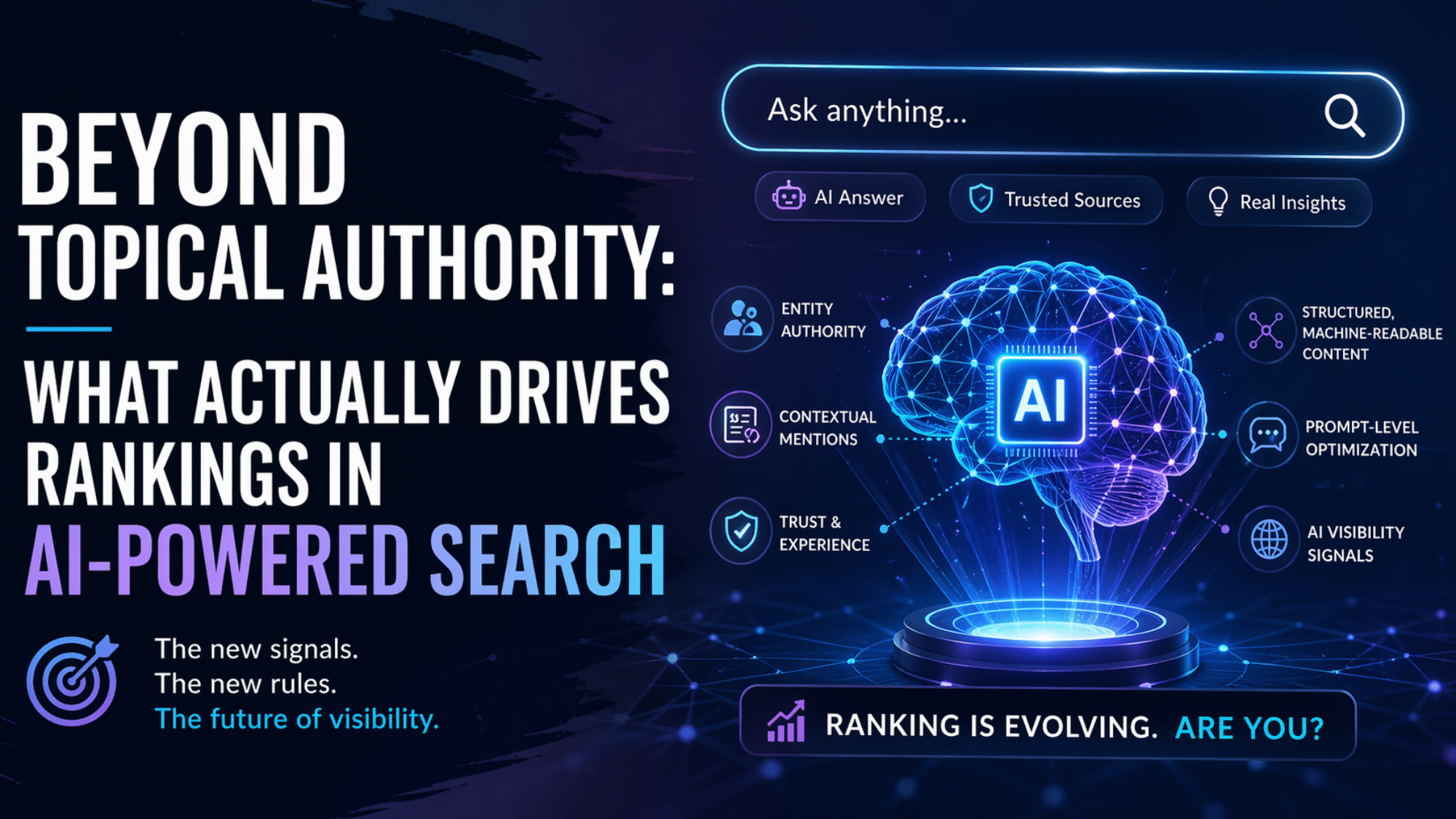
The End of Traditional SEO Comfort Zones
For years, topical authority has been the backbone of SEO strategy. Brands invested heavily in creating clusters of content around specific themes, believing that depth alone would secure rankings. That approach worked—when search engines relied primarily on keyword signals and backlink profiles.
But the rise of AI-powered search systems like ChatGPT, Google Gemini, and Perplexity AI has fundamentally changed how information is discovered, evaluated, and surfaced.
Today, ranking in AI search is no longer about who has written the most content on a topic. It’s about who is recognized, referenced, and trusted across the entire digital ecosystem.
Why Topical Authority Alone Is No Longer Enough
Topical authority still matters—but it has become a baseline, not a differentiator. AI systems don’t just scan your website; they synthesize information from multiple sources to generate answers.
This means your content is competing not just with other blogs, but with:
- Community discussions
- Expert commentary
- Brand mentions across the web
- Structured knowledge databases
AI doesn’t rank pages—it builds answers. And in that process, it prioritizes credible entities and contextual signals over sheer volume of content.
How AI-Powered Search Actually Determines Rankings
AI search operates on a fundamentally different model compared to traditional search engines. Instead of ranking pages, it evaluates:
Entity Understanding
AI identifies brands, people, and concepts as entities. If your brand isn’t clearly recognized as an entity, your chances of being cited in AI-generated responses drop significantly.
Contextual Relevance
It’s not just about matching keywords. AI evaluates how your content fits within a broader conversation. Are you being mentioned alongside relevant topics and authoritative sources?
Multi-Source Validation
AI models validate information by cross-referencing multiple sources. If your content exists in isolation, it lacks the reinforcement needed to be trusted.
What Actually Drives Rankings Beyond Topical Authority
1. Entity Authority and Brand Recognition
In AI search, your brand is not just a website—it’s an entity. The more your brand is mentioned across trusted platforms, the stronger your entity authority becomes.
When AI repeatedly encounters your brand in meaningful contexts, it begins to associate you with specific topics. This increases the likelihood of your brand being included in generated answers.
2. Contextual Mentions and Co-Occurrence Signals
One of the most powerful ranking signals in AI search is co-occurrence—how often your brand appears alongside other authoritative entities or relevant topics.
For example, if your brand is consistently mentioned in discussions about “AI search optimization” alongside recognized industry leaders, AI models start to position you within that ecosystem.
This is why digital PR, citations, and thought leadership content are becoming more important than traditional backlinks.
3. First-Hand Experience and E-E-A-T Evolution
AI systems prioritize content that demonstrates real expertise and experience. Generic, surface-level content is increasingly ignored.
Instead, AI favors:
- Original insights
- Case studies
- Real-world examples
- Expert-driven narratives
This aligns with the evolution of E-E-A-T (Experience, Expertise, Authoritativeness, Trustworthiness), but with a stronger emphasis on demonstrable experience.
4. Structured and Machine-Readable Content
AI models process content differently than humans. Clear structure improves your chances of being extracted and cited.
This includes:
- Semantic HTML structure
- Schema markup
- Clear headings and contextual hierarchy
- Concise, answer-ready paragraphs
Content that is easy to parse is more likely to be used in AI-generated summaries.
5. Prompt-Level Optimization and Conversational Intent
A major shift in SEO is the rise of prompt-driven search behavior. Users are no longer typing keywords—they are asking full questions.
To rank in AI-powered search, your content must align with how people interact with tools like ChatGPT and Perplexity AI.
This means:
- Targeting long-tail, conversational queries
- Answering specific user intents clearly
- Structuring content in a Q&A-friendly format
Content that directly answers prompts is far more likely to be surfaced.
The Rise of AI Visibility Signals
A new category of ranking factors is emerging—AI visibility signals.
These include:
- Mentions in forums like Reddit and Quora
- Reviews and user-generated content
- Inclusion in industry roundups
- Citations in authoritative blogs and publications
AI models are trained on diverse datasets. If your brand appears across multiple touchpoints, it strengthens your visibility.
How to Adapt Your SEO Strategy for AI Search
To succeed in this new landscape, brands must move beyond a website-centric approach and adopt a search everywhere strategy.
Start by building your presence across platforms where your audience and industry conversations exist. Focus on getting mentioned, not just indexed.
Invest in content that offers unique insights rather than repeating what already exists. Create material that others want to reference, quote, and share.
At the same time, ensure your content is structured in a way that AI can easily understand and extract. Clarity is no longer optional—it’s a ranking factor.
From Content Depth to Contextual Authority
Topical authority is no longer the ultimate goal—it’s just the starting point.
In AI-powered search, visibility is driven by context, credibility, and connection. It’s not about how much you publish, but how often you are recognized across the digital landscape.
The future of SEO belongs to brands that understand this shift—those that move from creating content in isolation to building authority across ecosystems.
Because in AI search, you don’t just rank.
You are chosen.